
Introduction
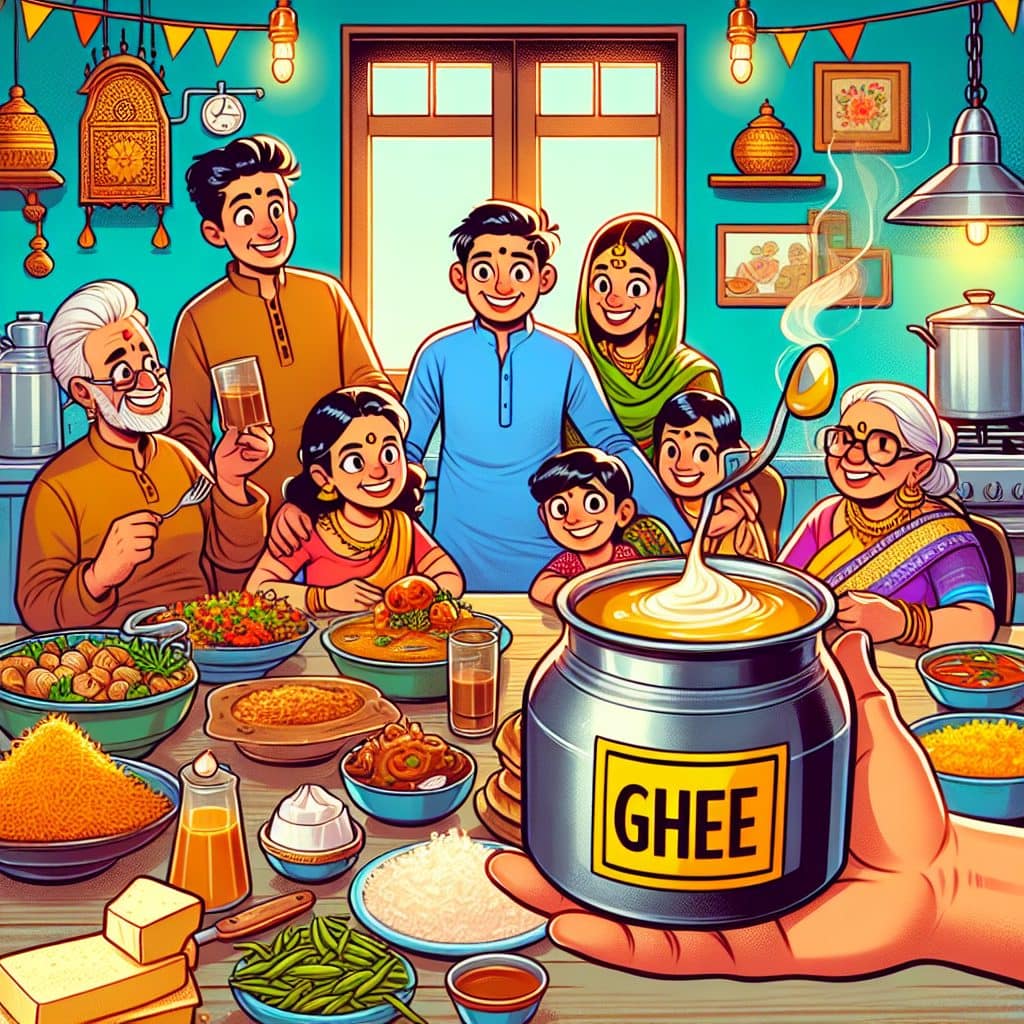
Meet Sunita Sharma, 58, retired school teacher from Jaipur, who has not allowed a single meal to leave her kitchen without a generous tablespoon of ghee since approximately 1987. Her daughter-in-law, Priya, 29, fitness enthusiast and intermittent fasting devotee, watches in quiet horror every evening as Sunita drowns perfectly good dal in a golden river of clarified butter. “Beta, this is liquid gold,” Sunita says, with the confidence of someone who has never Googled a single nutrition fact in her life. “Your dadi lived to 94. You know what she ate every morning? Ghee. With everything.“
Meanwhile, Priya’s WhatsApp group — “CLEAN EATING QUEENS 🥗✨” — has spent the last three weeks debating whether ghee is a superfood or a slow-acting cardiac assassination tool. One member shared an Instagram reel from a shirtless influencer who called ghee “basically poison.” Another forwarded an Ayurvedic practitioner’s post claiming ghee cures everything from joint pain to existential dread. Priya is now caught between her mother-in-law’s ancestral wisdom and a man whose primary qualification is visible abs.
And honestly? This is the most Indian dilemma that has ever existed.
Here’s the thing nobody wants to tell you: the ghee debate isn’t really about ghee. It’s about an entire wellness industry that profits from your confusion. Every time you’re torn between “ghee is sacred” and “ghee will kill you,” someone is selling you a Rs 2,400 cold-pressed alternative or a “fat-free cooking masterclass.” Because confused people buy more programs, more supplements, more “revolutionary” kitchen gadgets, and more absolute nonsense. The real enemy here isn’t the golden spoonful on your roti. It’s the machinery that keeps you terrified of your own grandmother’s cooking.
What Is Ghee?
Before we go to war with WhatsApp uncles and Instagram nutritionists, let’s actually understand what ghee IS — because half the people arguing about it couldn’t explain the difference between ghee and regular butter if their gym membership depended on it.
Think of ghee like this. Imagine butter is a joint family living in a 3BHK apartment. You’ve got the fat (the main earners, doing the heavy lifting), the milk solids (the relatives who showed up uninvited and never left), and water (the neighbour who keeps wandering in to borrow sugar). When you make ghee, you’re essentially evicting the water AND the uninvited relatives. You simmer butter slowly, the water evaporates, the milk solids settle to the bottom and get strained out, and what’s left is pure, golden, concentrated fat — the quiet, powerful, debt-free homeowner of the apartment.
That’s ghee. Clarified butter. No lactose. No casein. Just clean, stable, high-smoke-point fat that has been the backbone of Indian cooking for roughly 5,000 years — long before anyone invented the concept of a “macro split.”
The Nutritional Breakdown (Per Tablespoon — ~14g)
- Calories: ~120 kcal
- Total Fat: ~14g (roughly 62% saturated, 29% monounsaturated, 4% polyunsaturated)
- Cholesterol: ~33mg
- Vitamins: A, D, E, K (fat-soluble — meaning your body NEEDS fat to absorb them)
- Butyric acid: A short-chain fatty acid that feeds your gut lining
- Conjugated Linoleic Acid (CLA): Present in small amounts, linked to anti-inflammatory effects
- Carbs/Protein: ZERO. None. It’s pure fat, and it has made peace with that identity.
Now look at that list again. Does it look like poison to you? Does it look like a miracle cure for 47 diseases? No. It looks like a fat. A very specific, very useful, very calorie-dense fat. And that distinction — between “good food” and “magic potion” — is where all the chaos begins.
Why Should You Care?
Because you’re being lied to from both sides, and it’s costing you either your health or your sanity — sometimes both.
On one side, you have the Ghee Worship Brigade — your grandmother, three WhatsApp uncles, every Ayurvedic brand with a Instagram ad budget, and that one relative who genuinely believes a spoonful of warm ghee on an empty stomach will “flush toxins” the way a pressure washer cleans a driveway. On the other side, you have the Fat-Free Fear Factory — calorie-counting apps that turn red when you add ghee, fitness influencers who cook with water (WATER, bhai), and an entire generation that has been trained to believe all saturated fat is one cheese paratha away from a heart attack.
Both sides are wrong. And the longer you ping-pong between them, the longer you stay confused, the longer you keep buying things you don’t need, and the longer your actual relationship with food stays broken.
Let’s fix that. Starting with the lies.
The Ghee Myth Factory: How We Got Here
Let’s go back to our joint family apartment analogy. Ghee — the debt-free homeowner — was living peacefully in Indian kitchens for thousands of years. Nobody questioned it. Nobody weighed it. Your nani put it on your roti, your dada drank it with warm milk, and everyone moved on with their lives.
Then, in the 1960s and 70s, a very loud American scientist named Ancel Keys basically pointed at saturated fat and screamed, “THIS IS THE MURDERER!” His research (which has since been heavily criticized for cherry-picking data from only the countries that supported his hypothesis) convinced the Western world that all saturated fat = heart disease = death. Suddenly, the entire planet decided that fat was the enemy. Refined seed oils became “heart healthy.” Margarine — a substance that is essentially one molecule away from plastic — became the hero. And ghee? Ghee got a criminal record.
India, desperate to modernize and adopt Western health standards, followed suit. Government health campaigns in the 80s and 90s actively discouraged ghee consumption. Refined vegetable oils flooded the market with “heart-friendly” labels. Dalda vanaspati — a hydrogenated, trans-fat-loaded nightmare — was marketed as the safe alternative to ghee. Let that sink in. We replaced a 5,000-year-old whole food with industrially processed trans fats and called it progress.
Now the pendulum has swung violently the other way. Ghee is being sold as a “superfood” — a word that means absolutely nothing scientifically but sells a LOT of overpriced jars on Amazon. Brands charge Rs 800-2,000 for “A2 Bilona grass-fed hand-churned moonlight-blessed ghee” as if cows are performing yoga in Rishikram before being milked. The truth, as always, is somewhere in the boring, unglamorous middle.
Uncle’s Logic vs Reality Check
Myth #1: “Ghee burns belly fat if you drink it on an empty stomach”
“Beta, one spoon of warm ghee in the morning, empty stomach — it melts the fat inside your body. Like butter on a hot tawa!”
Reality Check: Your body is not a tawa. Fat is not butter sitting on a surface waiting to be melted by more fat. That is NOT how any of this works. When you drink ghee on an empty stomach, your body digests it, breaks it into fatty acids, and either uses it for energy or stores it — exactly like any other fat. Adding fat does not subtract fat. That’s not biology, that’s not even basic maths. If drinking ghee melted belly fat, every grandmother in Punjab would have a six-pack. They don’t. Case closed.
Myth #2: “Ghee has no cholesterol because it’s pure”
“Arrey, ghee is pure desi fat. No cholesterol. Only the processed oils have cholesterol. Our ancestors never had heart problems!”
Reality Check: Ghee contains approximately 33mg of cholesterol per tablespoon. It is an animal fat. It absolutely has cholesterol. Now — here’s the nuance your uncle will never forward on WhatsApp — dietary cholesterol has a much smaller impact on blood cholesterol than we were told in the 1990s. For most healthy people, moderate ghee consumption doesn’t spike cholesterol levels dangerously. But saying it has ZERO cholesterol? That’s not ancestral wisdom, that’s just lying with extra confidence. Your ancestors also walked 15 km a day, ate one-third the calories, and didn’t sit in an AC office for 10 hours. Context matters.
Myth #3: “You can eat unlimited ghee because it’s natural”
“It’s natural, beta. Natural things can’t be bad for you. Eat as much as you want. Your body knows.”
Reality Check: Cobra venom is also natural. Arsenic occurs naturally. The sun is natural and it will absolutely give you cancer if you stand in it long enough. “Natural” is not a free pass to abandon all proportion. Ghee is ~120 calories per tablespoon. If you’re adding 3-4 tablespoons to every meal — which many Indian households absolutely do — that’s 360-480 EXTRA calories per meal from fat alone. Over a day, that could be 1,000+ calories just from ghee. Your body doesn’t care that it’s natural. It cares about energy balance. Calories don’t have a “desi exemption.”
Myth #4: “Ghee is bad for the heart — switch to refined oil”
“Doctor sahab said no ghee. Only refined sunflower oil. It says ‘heart healthy’ on the bottle!”
Reality Check: This is the myth that arguably did the most damage to Indian health. Many refined seed oils are high in omega-6 polyunsaturated fats, which when consumed in excess — and when heated repeatedly at high temperatures, as Indian cooking demands — can produce oxidized compounds and promote inflammation. Meanwhile, ghee has a smoke point of roughly 250°C (482°F), making it one of the most stable cooking fats available. It doesn’t break down into harmful compounds when you’re making tadka at high heat. The refined oil on your shelf, with its cheerful heart logo, often can’t say the same. This doesn’t mean ghee is harmless in unlimited quantities. It means the replacement was often worse than the original.
The Science Nobody Tells You (Because It Doesn’t Sell Programs)
Let’s strip away the mythology, the marketing, and the WhatsApp forwards and look at what ghee actually does inside your body.
What ghee DOES:
- Provides butyric acid — a short-chain fatty acid that nourishes the cells lining your colon, supports gut barrier integrity, and has demonstrated anti-inflammatory properties in multiple studies. Your gut bacteria also produce butyrate when you eat fiber, but ghee gives you a direct dietary source.
- Delivers fat-soluble vitamins (A, D, E, K) — and because it IS fat, it actually helps your body absorb these vitamins from other foods in the same meal. That dal-chawal with a teaspoon of ghee? Your body absorbs more nutrients from it than the same dal without fat. That’s not magic. That’s biochemistry.
- Provides a stable cooking medium — high smoke point means fewer toxic aldehydes and oxidation byproducts compared to many vegetable oils when used for Indian-style high-heat cooking (tadka, frying, roasting).
- Contains CLA (Conjugated Linoleic Acid) — especially in ghee from grass-fed cows. CLA has shown modest anti-inflammatory and body composition benefits in some studies, though the amounts in ghee are small.
- Is virtually lactose and casein-free — making it tolerable for many people with dairy sensitivities (though not all — severe allergies still warrant caution).
What ghee does NOT do:
- Does NOT “detoxify” your body. Your liver and kidneys handle detoxification. Ghee is not a cleaning service.
- Does NOT “boost metabolism” in any meaningful way. No single food does. This claim is the nutritional equivalent of saying one match can heat a building.
- Does NOT cure joint pain, arthritis, or inflammation on its own. It may have mild anti-inflammatory properties. Mild. It’s not ibuprofen.
- Does NOT cancel out an otherwise terrible diet. Adding ghee to Maggi, white bread, and three cups of chai with sugar doesn’t create a “balanced meal.” It creates an expensive calorie bomb.
- Does NOT make you immune to heart disease just because your grandmother survived on it. Survivorship bias is real. You remember dadi who lived to 94. You don’t remember the ones who didn’t.
Remember Sunita Sharma, our ghee-generous retired teacher? She walks 4 km every morning at the park, eats home-cooked meals, rarely snacks, and her total daily calorie intake — even with the ghee — hovers around a reasonable 1,600-1,800 calories. Her ghee consumption works FOR her because the rest of her lifestyle supports it. Now look at her son, Vikram, 33, Pune-based IT professional, who adds ghee to every meal but ALSO orders Swiggy twice a day, drinks three sugary coffees, and walks approximately 1,200 steps total. Same ghee. Completely different outcome. The spoon didn’t change. The lifestyle did.
Ghee and Your Body: The Uncomfortable Truth
What Ayurveda ACTUALLY Said
Ayurvedic texts — specifically Charaka Samhita and Sushruta Samhita — recommended ghee as part of a balanced, personalized dietary framework. The dosage was specific. It was adjusted by body type (prakriti), season (ritu), digestive capacity (agni), and activity level. Ghee was considered “sattvic” — calming and nourishing — but it was NEVER prescribed as “eat unlimited amounts with everything.” Ayurveda explicitly warned against excess fat consumption for people with weak digestion or sedentary lifestyles. Explicitly.
What Your WhatsApp Group THINKS It Said
“Ghee is divine. More ghee = more health. Our ancestors ate ghee by the kilo and lived to 150. Science is Western propaganda. Share this message with 10 people for good health. 🙏🕉️🐄”
Common Ground
Both Ayurveda and modern nutritional science agree on this: ghee is a high-quality fat that has a legitimate place in the human diet, in appropriate quantities, adjusted for individual needs. Neither system — when properly understood — tells you to drown your food in it. Neither tells you to eliminate it entirely. The boring answer is the correct one: moderate, mindful, and matched to your actual lifestyle.
Let’s look at a real conversation from Priya’s WhatsApp group:
Neha: “Guys I read that A2 ghee has completely different properties than regular ghee. Like it goes to your cells differently??”
Meghna: “Haan yaar, A2 is from desi cows. The protein is different. It’s basically medicine.”
Priya: “But ghee doesn’t even have protein? The milk solids are removed?”
Neha: “…”
Meghna: “…”
Sunita (who was silently added to the group by her son): “Just eat the ghee, beta. 🙏”
Here’s the truth about A2 vs A1 ghee: the A1/A2 distinction refers to the type of beta-casein protein in milk. Since ghee is clarified butter with milk solids REMOVED, the A1/A2 difference becomes largely irrelevant in the final product. The fatty acid profile may differ very slightly based on the cow’s breed and diet (grass-fed vs grain-fed matters more), but paying three times the price specifically for “A2 ghee” is mostly paying for marketing, not biochemistry. Obviously.
The Simple Fix
Alright, enough destruction. Let’s build something. Here’s how to actually use ghee like a rational human being who respects both science and their grandmother.
Step 1: Know Your Number
Total fat intake for most adults should be roughly 20-35% of total daily calories. For someone eating 2,000 calories/day, that’s 44-78 grams of fat. Ghee should be ONE source of fat in your diet — not the ONLY source. A reasonable daily ghee intake for most moderately active Indian adults: 1-3 teaspoons (5-15g), distributed across meals.
Step 2: Use It Where It Matters Most
- For tadka/tempering: YES. This is where ghee shines — high smoke point, stable, adds flavour. Use 1 teaspoon per tadka.
- On roti/rice: YES, but measure it. One teaspoon on your roti, not a ladle. Your roti is not a swimming pool.
- For deep frying: Technically excellent due to stability, but deep frying in ghee regularly is a calorie apocalypse. Save it for festivals, not Tuesdays.
- In morning coffee/bulletproof style: If you enjoy it and account for the calories, fine. But it’s not a “metabolism hack.” It’s coffee with fat. That’s all.
Step 3: The Weekly Ghee Budget (A Real Framework)
Think of your weekly fat intake like a household budget. Ghee gets an allocation — not the entire salary.
- Monday-Friday (workdays, lower activity): 1-2 teaspoons/day — in cooking, on dal or roti
- Saturday-Sunday (more active, social meals): 2-3 teaspoons/day — can be slightly more generous with weekend meals
- Total weekly ghee budget: ~70-100g (roughly half a standard 200g jar per week)
- Balance with: Nuts, seeds, fish (if non-vegetarian), small amounts of cold-pressed mustard or coconut oil for variety
Step 4: Stop Compensating for Bad Habits with Ghee
Adding ghee to your diet does not fix:
- A lack of vegetables (most Indian diets are severely low in vegetables — yes, really)
- Excessive refined carbs (that third roti with extra ghee is still three rotis)
- Zero physical activity (ghee doesn’t exercise for you, you beautiful disaster)
- Chronic sleep deprivation (no amount of warm ghee milk fixes 5 hours of sleep)
Common Mistakes
Mistake #1: Treating ghee as a health supplement instead of a cooking fat. Ghee is food. It’s a very good cooking fat. It is NOT medicine. Stop taking it like a pill on an empty stomach expecting miracles. You’re just eating fat before breakfast. Congratulations.
Mistake #2: Eliminating ghee entirely because “saturated fat is bad.” The blanket demonization of saturated fat has been significantly challenged by research over the last two decades. Moderate saturated fat intake — within a balanced diet that includes fiber, vegetables, protein, and physical activity — has not been conclusively shown to increase heart disease risk in otherwise healthy individuals. Removing ghee and replacing it with refined seed oils heated to smoking point is arguably worse.
Mistake #3: Using ghee quantity as a measure of love or tradition. “Mere ghar mein toh ghee ki nadi bahti hai” is not a nutritional strategy. It’s a flex. Your love for your family can be expressed in portion-controlled amounts. Nobody’s affection is measured in tablespoons.
Mistake #4: Falling for premium branding without understanding what you’re paying for. Most of the Rs 1,500 “artisanal grass-fed A2 bilona method” ghee provides a nearly identical fatty acid profile to decent quality regular cow ghee that costs Rs 500-600 per kg. The difference is packaging, storytelling, and an Instagram aesthetic. If you can afford the premium and prefer the taste, go ahead. But don’t believe you’re buying fundamentally different nutrition. You’re buying a narrative.
Mistake #5: Ignoring individual health conditions. If you have diagnosed hyperlipidemia, familial hypercholesterolemia, existing cardiovascular disease, or your doctor has specifically asked you to limit saturated fat — LISTEN TO YOUR DOCTOR. Not your mother-in-law. Not this blog. Not a WhatsApp forward. Individual medical conditions override general dietary advice. Always.
Quick Summary
For those of you who scrolled past 2,000 words to get here — I see you, I respect the hustle, and here’s your cheat sheet:
- Ghee is a high-quality cooking fat — not a superfood, not a poison, not medicine.
- 1-3 teaspoons per day is a reasonable amount for most moderately active adults. Adjust based on your total calorie needs and activity level.
- It provides butyric acid, fat-soluble vitamins, and a stable cooking medium — these are real, science-backed benefits.
- It does NOT burn fat, detoxify your body, cure diseases, or cancel out an unhealthy diet.
- The A2/premium ghee market is mostly marketing. Good quality regular cow ghee does the job perfectly.
- Your grandmother’s ghee habit worked because her ENTIRE lifestyle was different — more movement, less processed food, smaller portions, less stress-eating at midnight.
- Context is everything. Ghee on a roti after a 5 km walk ≠ ghee on a paratha before sitting in a chair for 9 hours.
- If you have a specific medical condition, follow your doctor’s advice — not ancestral wisdom, not Instagram, not this article.
FAQ: Questions Your WhatsApp Group Is Too Embarrassed to Ask
Q: Can I eat ghee every day if I’m trying to lose weight?
Yes — IF you account for the calories. Ghee is calorie-dense (~120 kcal per tablespoon), so it needs to fit within your daily calorie target, not sit on top of it. One teaspoon on your dal or roti is roughly 45 calories — completely manageable. Four tablespoons drizzled over everything because “it’s healthy fat” is 480 extra calories — and that’s how weight loss stalls. Track it. Don’t fear it. Don’t ignore it. Fat doesn’t make you fat. Excess calories make you fat. Ghee just makes it very easy to accidentally eat excess calories because it’s delicious and your hand is generous.
Q: Is ghee better than butter?
For cooking, yes — ghee has a higher smoke point (~250°C vs butter’s ~175°C), is more shelf-stable, and doesn’t burn as easily during Indian high-heat preparations. For nutrition, they’re extremely similar — both are dairy fats with comparable calorie and fatty acid profiles. Ghee has the advantage of being virtually lactose and casein-free, so it’s better tolerated by people with mild dairy sensitivities. If you’re spreading something on toast at room temperature, butter is fine. If you’re making tadka, ghee wins. It’s not a moral choice. It’s a practical one.
Q: My doctor said to avoid ghee because of high cholesterol. But my family says ghee REDUCES cholesterol. Who’s right?
Your doctor. Full stop. While it’s true that the relationship between dietary saturated fat and blood cholesterol is more nuanced than we once believed, if you have diagnosed dyslipidemia or cardiovascular risk factors, your doctor’s personalized advice trumps every general wellness claim — including the ones in this article. Ghee does not reduce cholesterol. Some studies suggest moderate ghee intake doesn’t significantly RAISE it in healthy individuals, which is very different from saying it lowers it. Your family means well. Your doctor has your blood work. Go with the blood work.
Final Thoughts
Here’s what I want you to take away from this, and I want you to really let it sink in:
Ghee is not your enemy. Ghee is not your savior. Ghee is a fat. A really good, versatile, time-tested fat that deserves a measured, respected place in your kitchen — not a shrine and not a criminal record.
The Indian obsession with ghee is beautiful in its cultural roots and absolutely unhinged in its modern execution. We went from our grandmothers using it wisely within naturally balanced, physically active lifestyles to either worshipping it as liquid divinity or fearing it as liquid death — with no middle ground and no critical thinking in between.
Your body doesn’t care about tradition. It doesn’t care about Instagram. It doesn’t care about what your uncle forwarded at 6:14 AM with fourteen prayer emojis. It cares about how much you eat, how much you move, how well you sleep, and whether your overall dietary pattern makes sense. Ghee fits beautifully into a sensible pattern. It doesn’t replace one.
- Use 1-3 teaspoons daily. Measured. Intentional. Delicious.
- Stop treating food as either villain or hero. It’s just food. Eat it with respect and awareness.
- Your grandmother was right about ghee being good. She was also walking 8 km a day and eating 1,500 calories. Copy the whole lifestyle, not just the ghee part, you absolute mango.
Now tell me — what’s the most insane ghee claim you’ve heard from a family member? Drop it in the comments. I need to know what we’re dealing with here. 👇