

The Great Indian Kitchen Oil Showdown: Olive vs Mustard vs Coconut – Which Oil Actually Wins for Your Health?
Introduction
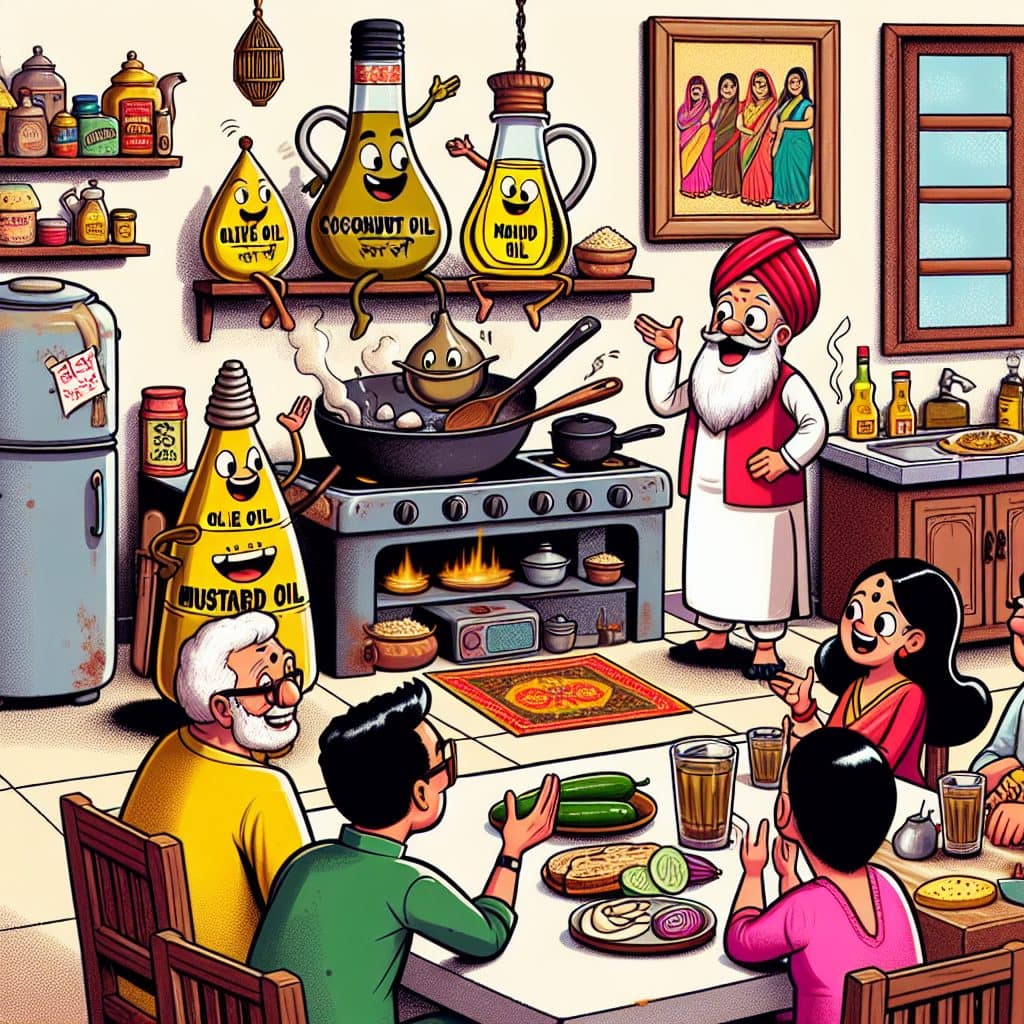
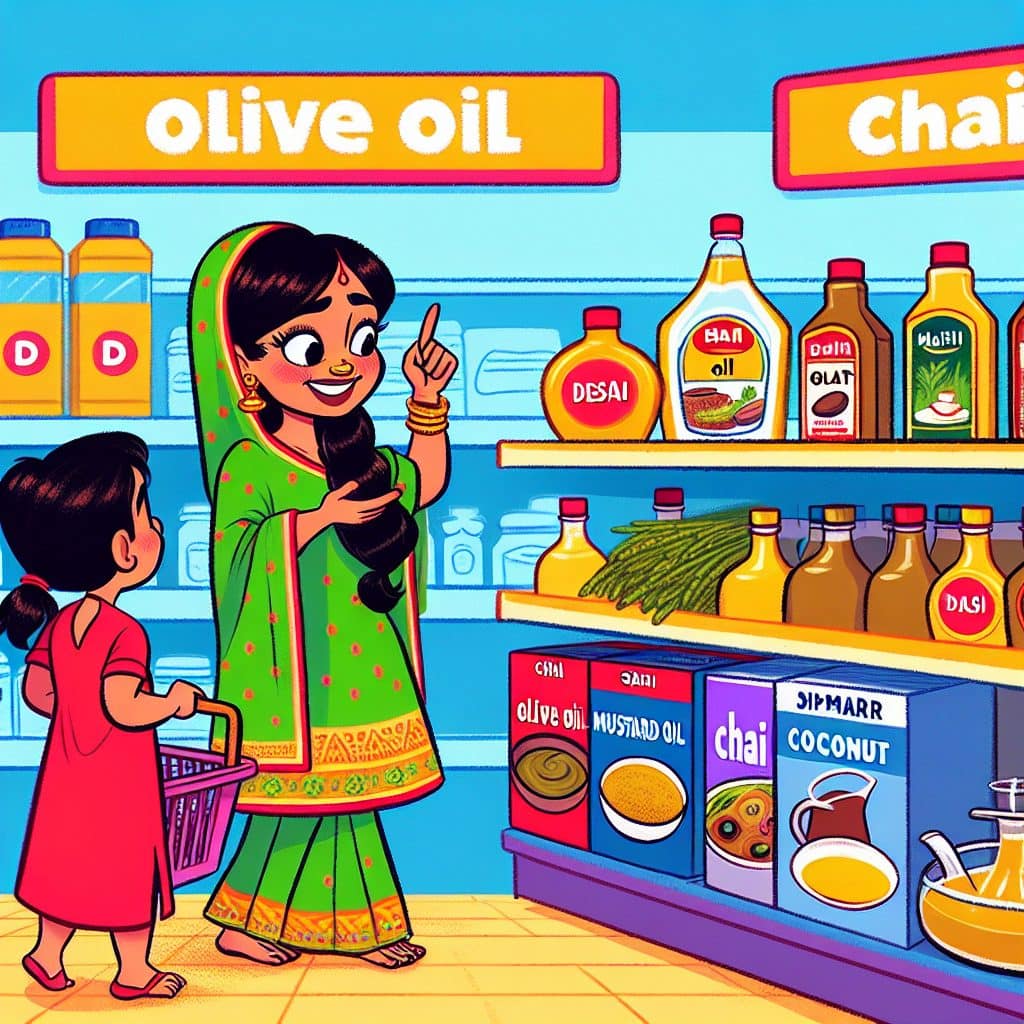
Meet Sunita Sharma, 42, homemaker from Jaipur, standing in the cooking oil aisle of D-Mart at 11 AM on a Saturday, holding a bottle of extra virgin olive oil in her right hand and a tin of yellow mustard oil in her left, looking like she’s defusing a bomb. Her phone is open to a WhatsApp forward titled “OLIVE OIL IS LIQUID GOLD — Doctors are HIDING this from you!!!” that her sister-in-law sent at 6:47 AM with exactly fourteen prayer emojis. Her mother called at 7:30 AM to remind her that “humne toh hamesha sarson ka tel hi use kiya hai, aur dekho hum kitne healthy hain” — conveniently forgetting her own BP medication sitting on the kitchen counter. And last night, her husband Vinod forwarded a YouTube thumbnail from a man with unnervingly white teeth claiming that coconut oil cures everything from joint pain to existential dread.
Sunita has been standing in this aisle for eleven minutes. She is no closer to a decision. She might actually cry.
And honestly? That’s EXACTLY where the cooking oil industry wants her. Because confused people buy the most expensive bottle on the shelf, thinking price equals health. Confused people switch oils every three months based on whatever Netflix documentary their cousin watched. Confused people spend ₹900 on imported extra virgin olive oil and then deep fry pakodas in it — destroying every single compound that made it worth ₹900 in the first place. Who benefits from this confusion? Every brand that slaps “heart healthy” on a label and charges you triple. Every influencer who gets paid to hold a bottle of oil next to their abs. Every WhatsApp forward that ends with “SHARE THIS BEFORE THE GOVERNMENT BANS IT.” The cooking oils truth is simpler, cheaper, and more boring than anyone profiting from your confusion wants you to know.
What Is the Cooking Oil Debate Really About?
Let’s get one thing straight before we go any further. The cooking oil debate isn’t really about which oil is “best.” That question makes about as much sense as asking “Which is the best vehicle — auto-rickshaw, Maruti Swift, or Indian Railways?” Best for WHAT? For whom? In what situation?
An auto-rickshaw is perfect for a 2-km ride through Chandni Chowk traffic. Put it on the Delhi-Mumbai expressway and you’ll die. A Maruti Swift is great for daily commutes. Try fitting a joint family of fourteen in it for a wedding trip and you’ll wish you’d booked a train. Indian Railways can move 800 people across 2,000 km — but you wouldn’t take it to buy sabzi from the market.
Cooking oils work EXACTLY the same way.
Every oil has a job it does brilliantly and a job it does terribly. The problem is that we’ve been told there’s ONE magical oil that does everything — sautéing, deep frying, salad dressing, tadka, baking, and probably fixing your marriage. There isn’t. There never was. And anyone selling you that story is selling you a bottle, not the truth.
The cooking oils truth comes down to three things that actually matter:
- Smoke point — the temperature at which an oil starts breaking down and releasing harmful compounds. Cross this, and your “healthy” oil becomes a chemistry experiment.
- Fatty acid profile — the ratio of saturated, monounsaturated (MUFA), and polyunsaturated (PUFA) fats. This determines what the oil does inside your body.
- Processing method — cold-pressed, expeller-pressed, refined, or solvent-extracted. This determines what’s LEFT in the oil by the time it reaches your kitchen.
That’s it. That’s the entire framework. Everything else is marketing.
The Vehicle Analogy — Your Quick Reference
We’re going to use this vehicle analogy throughout, so burn it into your brain:
- Mustard oil = the Ambassador. Old school, Indian, built for Indian roads, tough as nails, your grandfather swore by it, and science says grandpa was mostly right.
- Coconut oil = the auto-rickshaw. Absolutely brilliant for short trips and specific jobs. Terrible if you think it’s the answer to everything.
- Olive oil (extra virgin) = the imported sedan. Beautiful engineering, genuinely excellent — but only on the right roads. Put it on the wrong road and you’ve wasted your money.
- Refined oils = the rental car with a suspiciously clean exterior. Looks fine. Runs okay. But pop the hood and you have NO idea what’s been done to the engine.
Why Should You Care About Which Cooking Oil You Use?
Here’s a number that should make you put down your phone and stare at your kitchen shelf: the average Indian family uses 15 to 20 litres of cooking oil per person per year. For a family of four, that’s 60 to 80 litres annually. Over a decade, that’s 600 to 800 litres of oil passing through your family’s bodies.
Let that sink in. That’s not a dietary footnote. That’s a river. A slow, steady, decade-long river of fat flowing through your arteries, your liver, your heart. And you’re telling me you chose which oil to pour into that river based on a WhatsApp forward from Vinod Chacha?
India has seen a dramatic rise in heart disease, Type 2 diabetes, and inflammatory conditions over the last 40 years — and the timeline maps almost perfectly onto our national shift from traditional cold-pressed oils (mustard, groundnut, coconut, sesame) to industrially refined oils (soybean, sunflower, “vegetable” oil blends). Correlation isn’t causation — your science teacher was right about that — but when the correlation is this strong, this consistent, and backed by metabolic research, you’d be a fool to ignore it.
The Indian Council of Medical Research (ICMR) and the National Institute of Nutrition (NIN) have been saying for years that Indians need to reduce total oil consumption AND improve the quality of oil they use. But that message doesn’t sell. You know what sells? “SWITCH TO THIS ONE OIL AND NEVER WORRY AGAIN!”
Nobody’s buying a headline that says “Use less oil, rotate between 2-3 good ones, and match the oil to your cooking method.” But that’s the cooking oils truth. Boring. Practical. Life-saving.

Uncle’s Logic vs Reality Check
Time to enter the battlefield. Your family WhatsApp group “Sharma Parivar 🙏🏠❤️” has opinions. Strong ones. Let’s address them.
Myth #1: “Olive oil is the healthiest oil in the world — use it for everything”
Uncle’s Logic: “Beta, Europeans use olive oil and they don’t have heart attacks. We should also switch to olive oil for all cooking. I read it on Google.”
Reality Check: Europeans also walk 8,000-12,000 steps daily, eat dinner at 8 PM instead of 10:30 PM, and don’t deep fry samosas at a cousin’s surprise mundan ceremony. If imported = better, then drink imported American cola daily and see what happens to your health. Extra virgin olive oil has a smoke point of around 160-190°C. Indian tadka hits 200°C+. Deep frying hits 180-220°C. That means every time you heat EVOO past its smoke point, you’re breaking down the very polyphenols and antioxidants you paid ₹900 for, and generating aldehydes — toxic compounds that are genuinely harmful. EVOO is BRILLIANT for salad dressings, light sautéing, drizzling over cooked food, and low-heat cooking. It is NOT your deep frying oil. Stop making it do a job it was never designed for.
One line summary: Olive oil is the imported sedan — magnificent on smooth highways, destroyed on potholed village roads. Match the oil to the job.
Myth #2: “Mustard oil is banned in many countries — it must be dangerous”
Uncle’s Logic: “Arrey, mustard oil is banned in America and Europe! If goras have banned it, there must be something wrong. We should stop using it.”
Reality Check: Mustard oil is sold in the US and EU as “for external use only” — not because it’s toxic, but because of regulatory standards around erucic acid content that were set based on 1970s rat studies using doses no human would ever consume. If banned in the West = dangerous, then we should also ban turmeric (not approved as medicine by the FDA), raw milk (illegal to sell in many US states), and mangoes (were literally banned from US import until 2007). The erucic acid concern was based on studies where rats were fed erucic acid as 50% of their total caloric intake. FIFTY PERCENT. You’d need to drink mustard oil like water to replicate that. Modern low-erucic acid mustard oil varieties exist, and traditional Indian consumption levels have never shown the cardiac damage seen in those extreme rat studies. Meanwhile, mustard oil is rich in MUFA, has a high smoke point (~250°C), contains natural antimicrobial compounds, and has been the backbone of North Indian cooking for centuries. Your great-grandmother used it. She was fine. She was probably tougher than you.
One line summary: Mustard oil is the Ambassador — not glamorous, built for Indian conditions, and your dadi knew what she was doing.
Myth #3: “Coconut oil is a superfood — use it for everything”
Uncle’s Logic: “Haan bhai, coconut oil cures everything. South Indians use it and they’re so healthy. I’m putting it in my coffee also now.”
Reality Check: Coconut oil is about 82% saturated fat. That’s higher than butter. Higher than ghee. Now, before the coconut cult comes for me — not all saturated fat is created equal. Coconut oil contains medium-chain triglycerides (MCTs), particularly lauric acid, which the body processes differently than long-chain saturated fats. There IS some evidence that MCTs are metabolized faster. But “metabolized faster” does not mean “eat unlimited amounts with zero consequences.” If natural saturated fat = unlimited, then deep fry everything in ghee three times a day and see what your cardiologist says. Virgin coconut oil is excellent for moderate-heat cooking, South Indian preparations, and specific uses. It’s an auto-rickshaw — perfect for short, specific trips. But making it your ONLY oil, pouring it into coffee, slathering it on toast, and cooking every meal in it because a Bali wellness influencer told you to? That’s taking the auto-rickshaw on the expressway.
One line summary: Coconut oil is great in the rotation, disastrous as the only player on the team.
Myth #4: “Refined oil is clean and safe because it’s clear and odourless”
Uncle’s Logic: “Beta, refined oil is pure. See how clear it is! No smell, no colour. That means all the impurities are removed.”
Reality Check: You know what else is clear, odourless, and has had everything removed from it? Vodka. That doesn’t make it healthy. Refining oil involves degumming, bleaching, deodorizing, and sometimes solvent extraction using hexane — a petrochemical. This process removes colour, flavour, odour — and also removes a massive chunk of the vitamins, antioxidants, polyphenols, and phytosterols that made the original oil beneficial. If refined = safe, then why did India’s massive national shift from cold-pressed traditional oils to refined soybean and sunflower oils over the last four decades coincide almost perfectly with our explosion of cardiovascular disease and metabolic syndrome? The oil LOOKS cleaner. What it does inside your body is a very different story. You’ve essentially traded a rough-looking but mechanically solid Ambassador for a rental car that looks spotless but has a cracked engine block.
One line summary: Clear and odourless doesn’t mean clean. It means stripped. Your oil had a personality; the refinery beat it out of it.
The Science Nobody Tells You (Because It Doesn’t Sell Programs)
Alright, let’s get into the biology. No WhatsApp university degree required — just your actual brain.
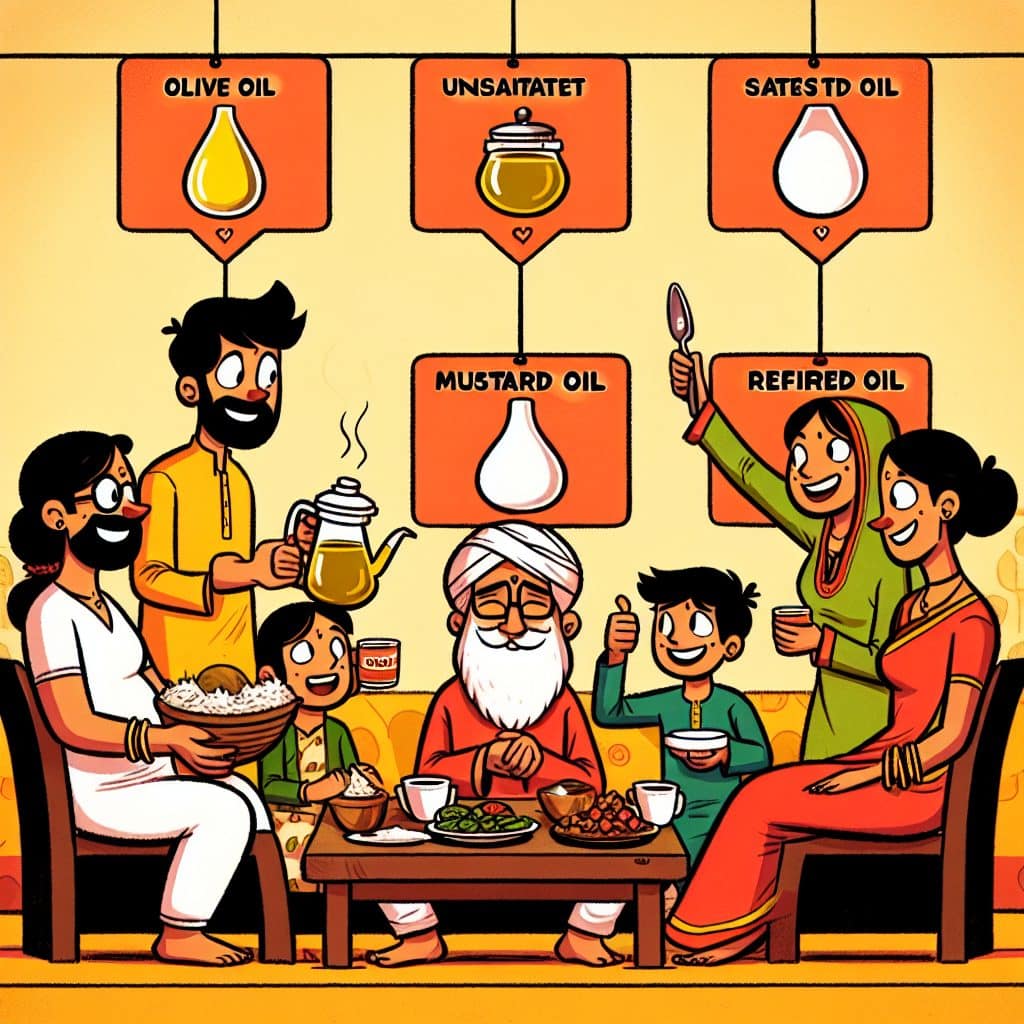
Fatty Acid Profiles — What Actually Matters
Every cooking oil is a combination of three types of fat:
- Saturated Fatty Acids (SFA) — solid at room temperature, stable under heat, but excess consumption is linked to increased LDL cholesterol.
- Monounsaturated Fatty Acids (MUFA) — the darling of heart health. Linked to reduced LDL, improved insulin sensitivity, and lower inflammation.
- Polyunsaturated Fatty Acids (PUFA) — includes Omega-3 and Omega-6. Essential (your body can’t make them), but the RATIO between Omega-6 and Omega-3 matters enormously.
Here’s the breakdown that nobody puts on a label:
Mustard Oil (cold-pressed/kachi ghani):
- ~60% MUFA (including erucic acid) | ~21% PUFA | ~12% SFA
- Has an almost ideal Omega-6 to Omega-3 ratio (~1.2:1 to 2:1)
- Smoke point: ~250°C — excellent for Indian high-heat cooking
- Contains allyl isothiocyanate — natural antimicrobial, anti-inflammatory
Coconut Oil (virgin, cold-pressed):
- ~82% SFA | ~6% MUFA | ~2% PUFA
- Rich in lauric acid (MCT) — faster metabolic pathway than long-chain SFA
- Smoke point: ~175°C (virgin) to ~230°C (refined)
- Best for moderate-heat cooking and specific regional cuisines
Extra Virgin Olive Oil:
- ~73% MUFA (oleic acid) | ~11% PUFA | ~14% SFA
- Loaded with polyphenols, oleocanthal (natural anti-inflammatory), and vitamin E
- Smoke point: ~160-190°C — NOT suitable for deep frying or high-heat tadka
- Best used raw, drizzled, or in light sautéing
Refined Soybean/Sunflower Oil:
- ~50-65% PUFA (overwhelmingly Omega-6) | ~20-25% MUFA | ~10-15% SFA
- Omega-6 to Omega-3 ratio: as high as 20:1 or worse
- Most antioxidants and micronutrients stripped during refining
- High Omega-6 load is linked to increased systemic inflammation
The Omega-6 Problem Nobody Talks About
What excess Omega-6 DOES in your body:
- Promotes pro-inflammatory pathways (prostaglandins, leukotrienes)
- Competes with Omega-3 for the same enzymes — so even if you eat fish, excess Omega-6 blocks Omega-3 utilization
- Oxidizes more easily when heated, forming harmful lipid peroxides
- Contributes to chronic low-grade inflammation — linked to heart disease, Type 2 diabetes, obesity, and autoimmune conditions
What excess Omega-6 does NOT do:
- Does NOT make your oil “heart healthy” just because it’s unsaturated
- Does NOT automatically lower cholesterol in a meaningful, protective way when the ratio is skewed
- Does NOT mean “better than saturated fat” when consumed in the wildly imbalanced amounts most Indians currently consume
The ideal Omega-6 to Omega-3 ratio is between 1:1 and 4:1. Most Indians eating refined soybean or sunflower oil as their primary cooking oil are hitting ratios of 15:1 to 20:1. That’s not nutrition. That’s inflammation on autopilot.
Remember Sunita from the D-Mart aisle? She switched her entire kitchen to refined sunflower oil three years ago because the bottle said “heart healthy” with a little red heart logo. Her husband Vinod’s latest blood work showed elevated inflammatory markers and borderline triglycerides. Their oil choice isn’t the only factor — but 60-80 litres a year flowing through your family? It’s not a footnote. It’s a headline.
Cooking Oils and Your Body: The Uncomfortable Truth
What Ayurveda ACTUALLY Said
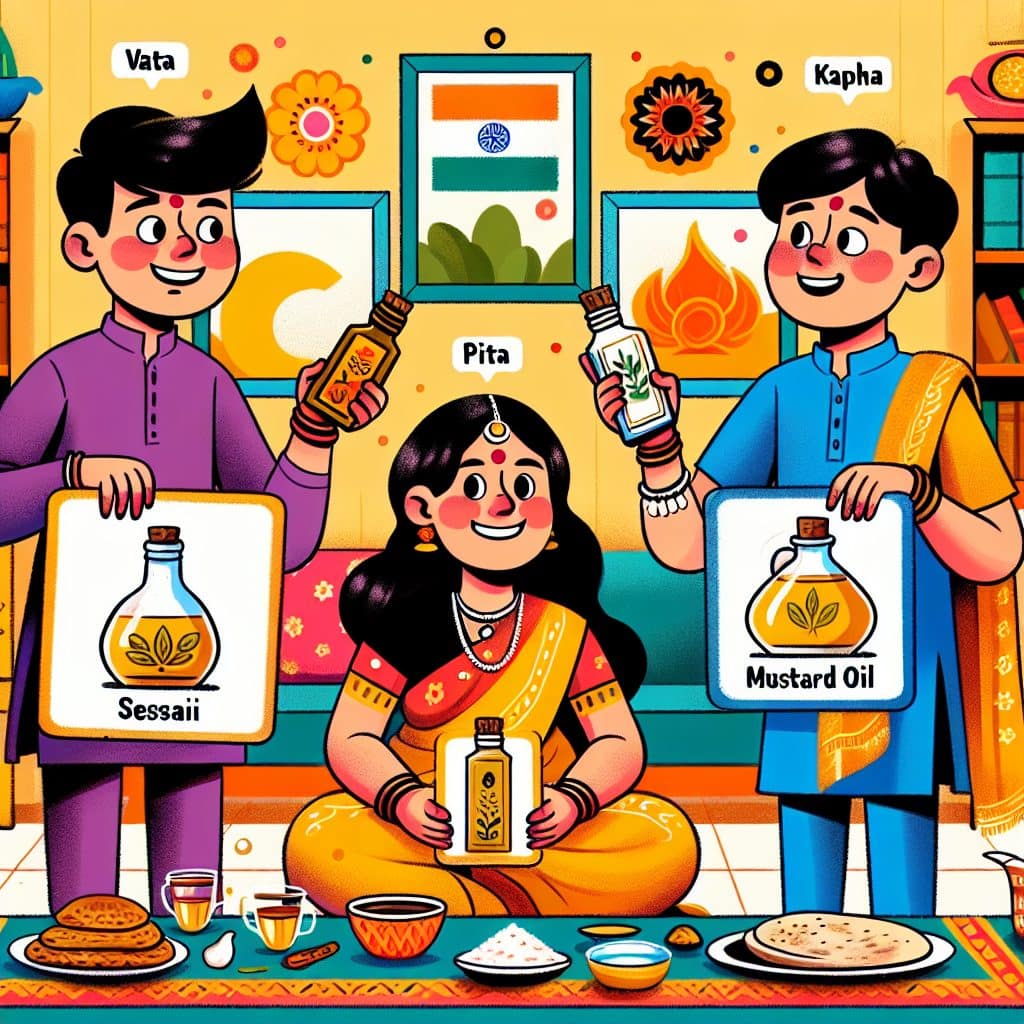
What Ayurveda ACTUALLY said: Different oils suit different body constitutions (prakriti), different seasons, and different geographical regions. Sesame oil for Vata. Coconut oil for Pitta. Mustard oil for Kapha. Oil should be consumed in moderation. Regional oils — oils that grow where you live — are most compatible with your body. This is called “desha-anusar ahara” — food according to your land.
What your WhatsApp group THINKS it said: “COCONUT OIL CURES ALL 108 DISEASES MENTIONED IN AYURVEDA! SHARE BEFORE GOVERNMENT REMOVES THIS POST! 🙏🙏🙏🔱”
Common ground: Both Ayurveda and modern nutritional science agree on one thing — there is no single universal “best” oil. Regional diversity, moderation, and minimal processing are principles that haven’t changed in thousands of years. Your great-grandmother rotated oils seasonally without reading a single PubMed paper. She was doing evidence-based nutrition before evidence-based nutrition had a name.
The Uncomfortable Numbers
Here’s what the data actually shows when you strip away the marketing:
- India’s consumption of refined soybean and sunflower oil increased by over 300% between 1980 and 2020.
- In the same period, cardiovascular disease became the #1 cause of death in India, accounting for nearly 28% of all deaths.
- The NIN (National Institute of Nutrition) recommends a daily oil intake of 20-25 grams per person (about 4-5 teaspoons). The average Indian urban household consumes 30-50 grams per person daily. That’s almost double the recommendation.
- A 2019 study published in The Lancet ranked India among the top countries for diet-related deaths, with excess sodium, insufficient whole grains, and poor fat quality as leading dietary risk factors.
The uncomfortable truth? Your cooking oil problem is two problems pretending to be one:
- You’re using too much oil. Every Indian recipe video starts with “take 3-4 tablespoons of oil.” That’s already your entire day’s allowance for one dish.
- The oil you ARE using has been stripped of everything useful and loaded with inflammatory Omega-6.
Fix both. Not one. Both.
Vinod, by the way, has started telling people at dinner parties that he’s “switched to olive oil for health reasons.” He deep fries his favourite mathri in it at 220°C. The olive oil weeps silently. The polyphenols are gone. The ₹900 is gone. Vinod’s smugness remains.
Battle Strategies: Real-World Implementation for Actual Humans
Enough theory. You’re Sunita. You’re standing in D-Mart. What do you actually PUT IN THE CART?
The Two-Oil System (Minimum Viable Strategy)
If you do nothing else — and I mean NOTHING else — do this:
- One high-heat oil for daily Indian cooking (tadka, sautéing, shallow frying, roti-making): Cold-pressed mustard oil (kachi ghani) OR cold-pressed groundnut/peanut oil (filtered) OR cold-pressed sesame/til oil — pick based on your region and palate.
- One finishing/low-heat oil for drizzling, salads, raita, light sautéing: Extra virgin olive oil OR virgin coconut oil (for South Indian households).
That’s it. Two oils. Done. You’ve already beaten 80% of Indian kitchens.
The Three-Oil Rotation (Optimal Strategy)
For the overachievers — and I say this with love, Sunita — here’s the ideal rotation:
- Daily cooking (high heat): Cold-pressed mustard oil OR cold-pressed groundnut oil — rotate monthly
- Occasional deep frying (if you must): Groundnut oil (smoke point ~230°C) or refined coconut oil (smoke point ~230°C). Yes, I said refined coconut oil for THIS specific use — the high smoke point matters more here than the polyphenol content you’d lose anyway at frying temperatures.
- Raw/finishing use: Extra virgin olive oil for Mediterranean-style dishes, salads, drizzling. Virgin coconut oil for South Indian chutneys, certain desserts.
- Ghee: 1-2 teaspoons daily for tadka, dal, roti. Ghee is not the villain. Ghee in a tablespoon is nutrition. Ghee by the ladle is self-sabotage.
The Weekly Reality Check
Here’s what a realistic week looks like for a North Indian family of four:
- Monday-Friday daily cooking: 2-3 teaspoons kachi ghani mustard oil per meal (tadka, sabzi, paratha). Total: ~15-20 ml per person per day. WITHIN the NIN guideline.
- Weekend treat (one deep-fried item): Groundnut oil, used ONCE, strained, stored in dark bottle, reused MAXIMUM one more time. Then discarded. Not reused seven times until it turns the colour of motor oil. THAT is how you get trans fats from oil that started with zero trans fats.
- Salad/raita nights: 1 teaspoon EVOO drizzled on top. NOT heated. NOT “sautéed a little.” Drizzled. On top. After cooking is done.
- Ghee: 1 teaspoon on dal, 1 teaspoon on roti, 2-3 times a week. Homemade if possible. Not the vanaspati-adulterated stuff.
What to Look for on the Label (The 10-Second Check)
- The words “cold-pressed” or “kachi ghani” or “wood-pressed” — these mean the oil was extracted mechanically, without chemical solvents.
- FSSAI mark — non-negotiable. Don’t buy unlabelled loose oil from dubious sources.
- Dark glass or tin packaging — light degrades oil. Clear plastic bottles are the worst storage medium.
- NO mention of “solvent extracted” anywhere on the label.
- Check manufacturing date, not just expiry. Cold-pressed oils are best used within 3-6 months.
Budget Reality
Yes, cold-pressed oils cost more than refined. A litre of kachi ghani mustard oil runs ₹180-280. Refined sunflower oil is ₹120-150. But here’s the math nobody does: if you reduce your oil consumption from 40 ml/person/day to the recommended 25 ml/person/day, you use 37% less oil monthly. A better oil at lower volume costs roughly the SAME as a worse oil at higher volume. Your wallet doesn’t suffer. Your arteries thank you. That’s not a health hack. That’s just arithmetic.

Common Mistakes Indians Make With Cooking Oils
Let’s do a quick WhatsApp group reality check. Here’s an actual conversation from “FIT BROS 💪” — a group of 23 grown men arguing about cooking oil at 11:47 PM on a Tuesday:
Friend 1: “Bro, I switched to olive oil completely. Full healthy mode on 🫒💪”
Friend 2: “Haan yaar, same. Wife makes aloo paratha in olive oil now. Tastes different but health first”
Friend 3: “My trainer said only coconut oil. Everything else is poison. He’s putting it in his protein shake also”
Friend 1: “Coconut oil in shake?? That’s next level bro”
Friend 4: “My uncle is a doctor. He said oil doesn’t matter. Just exercise.”
Every single person in this conversation is wrong. Here’s the complete mistake list:
- Using EVOO for deep frying or high-heat Indian cooking. You’re burning money and creating harmful compounds. Stop it.
- Reusing deep-frying oil 5-7 times. Each reheating cycle increases free radical content, trans fat formation, and polar compounds. Maximum 1-2 reuses for deep frying oil. Then THROW IT AWAY. Your thriftiness is not worth a cardiac event.
- Believing “cholesterol-free” labels. ALL plant oils are cholesterol-free. Cholesterol only comes from animal sources. Putting “cholesterol-free” on a bottle of vegetable oil is like putting “contains no gravel” on a bottle of water. It’s technically true and completely meaningless.
- Using only ONE oil for everything. No single oil has the perfect fatty acid profile. Rotating 2-3 oils gives you a broader spectrum of fatty acids and micronutrients. Your body isn’t asking for loyalty to one brand. It’s asking for variety.
- Storing oil in clear plastic bottles on the kitchen counter next to the stove. Heat + light + plastic = accelerated oxidation. Store oil in dark glass or tin, in a cool cabinet, away from the stove. This isn’t fussy. This is basic chemistry.
- Confusing “natural” with “unlimited.” Ghee is natural. Coconut oil is natural. Mustard oil is natural. Gravity is natural. Walk off a building and gravity will still kill you. Natural ≠ consequence-free. Dose matters. ALWAYS.
- Ignoring QUANTITY. The single biggest cooking oil mistake in India isn’t the wrong TYPE of oil — it’s the AMOUNT. Pouring oil like you’re filling a swimming pool, regardless of which oil it is, will mess with your lipid profile. The NIN says 20-25 ml per person per day. Measure it for one week. You will be horrified at how much you’ve been using.
Quick Summary
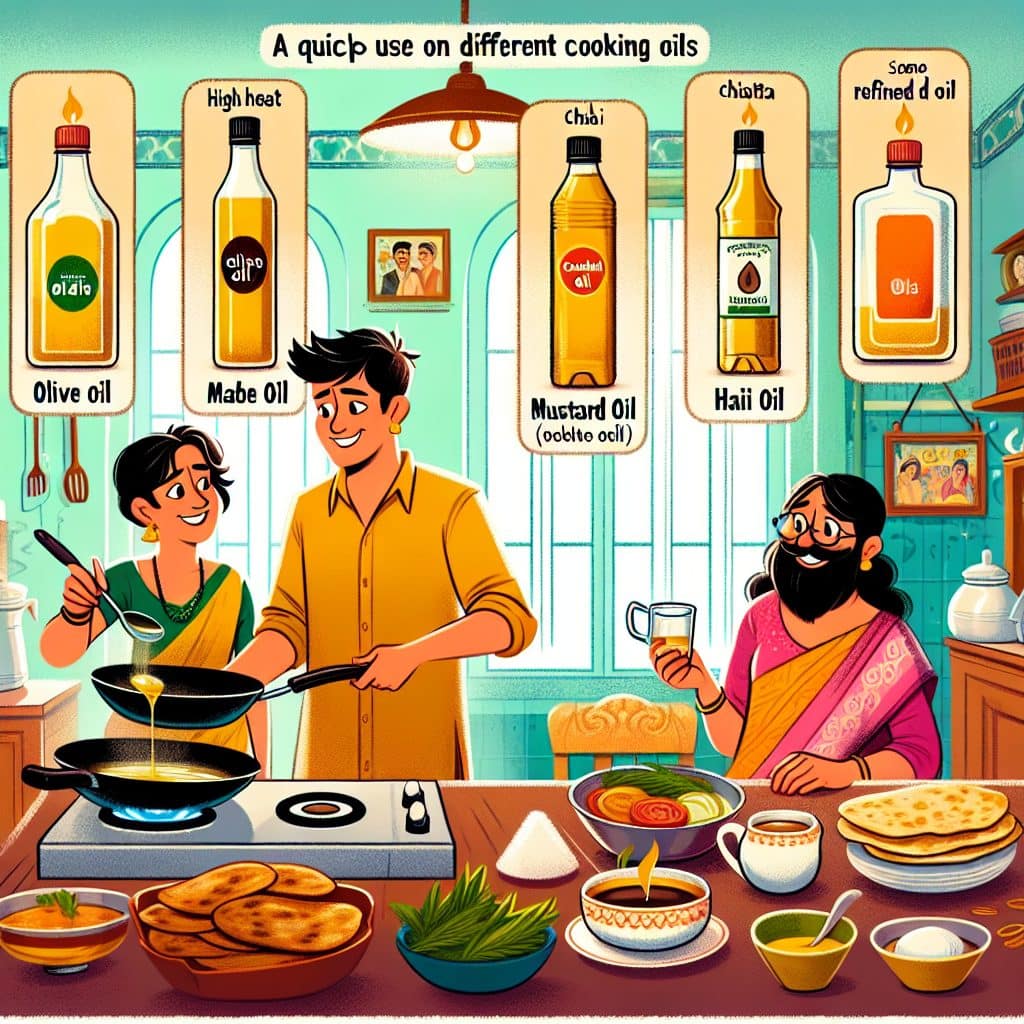
Because I know you’re going to screenshot this section and send it to your family WhatsApp group — and honestly, for once, that would actually be a useful WhatsApp forward — here’s the cooking oils truth in one clean table:
🟢 DAILY COOKING (High Heat — Tadka, Sautéing, Paratha):
Cold-pressed mustard oil, cold-pressed groundnut oil, cold-pressed sesame oil. Pick one based on your region. Rotate monthly.
🟡 OCCASIONAL DEEP FRYING (Once a week max, please):
Groundnut oil or refined coconut oil. Use once or twice. Discard. Do NOT reuse until it resembles crude petroleum.
🟢 RAW / FINISHING (Salads, Drizzle, Raita):
Extra virgin olive oil. Virgin coconut oil for South Indian use. NEVER heated past light sautéing temperatures.
🟢 GHEE (Because we’re Indian and this is non-negotiable):
1-2 teaspoons daily. Homemade or trusted brand. On dal, roti, rice. NOT by the ladle.
🔴 AVOID OR MINIMIZE:
Refined soybean oil, refined sunflower oil, refined “vegetable” oil blends, anything labelled “solvent extracted,” vanaspati/hydrogenated fat, any oil in a clear plastic bottle that’s been sitting in sunlight at a shop for three months.
📏 QUANTITY (The most important line in this entire post):
20-25 ml per person per day. Total. All oils combined. Measure it for one week. Then cry. Then adjust.

FAQ: Questions Your WhatsApp Group Is Too Embarrassed to Ask
Q: “Can I use just olive oil for all my cooking? I can afford it.”
A: This isn’t about money, yaar. It’s about chemistry. Extra virgin olive oil has a smoke point of ~160-190°C. Your kadhai hits 200-220°C for tadka and frying. Past the smoke point, EVOO’s beneficial polyphenols break down and harmful aldehydes form. Use EVOO for raw applications and light sautéing. For high-heat Indian cooking, use mustard or groundnut oil with higher smoke points. Your wallet can afford olive oil. Your olive oil can’t afford your tadka temperature. Two different problems.
Q: “Is rice bran oil a good option? My doctor recommended it.”
A: Rice bran